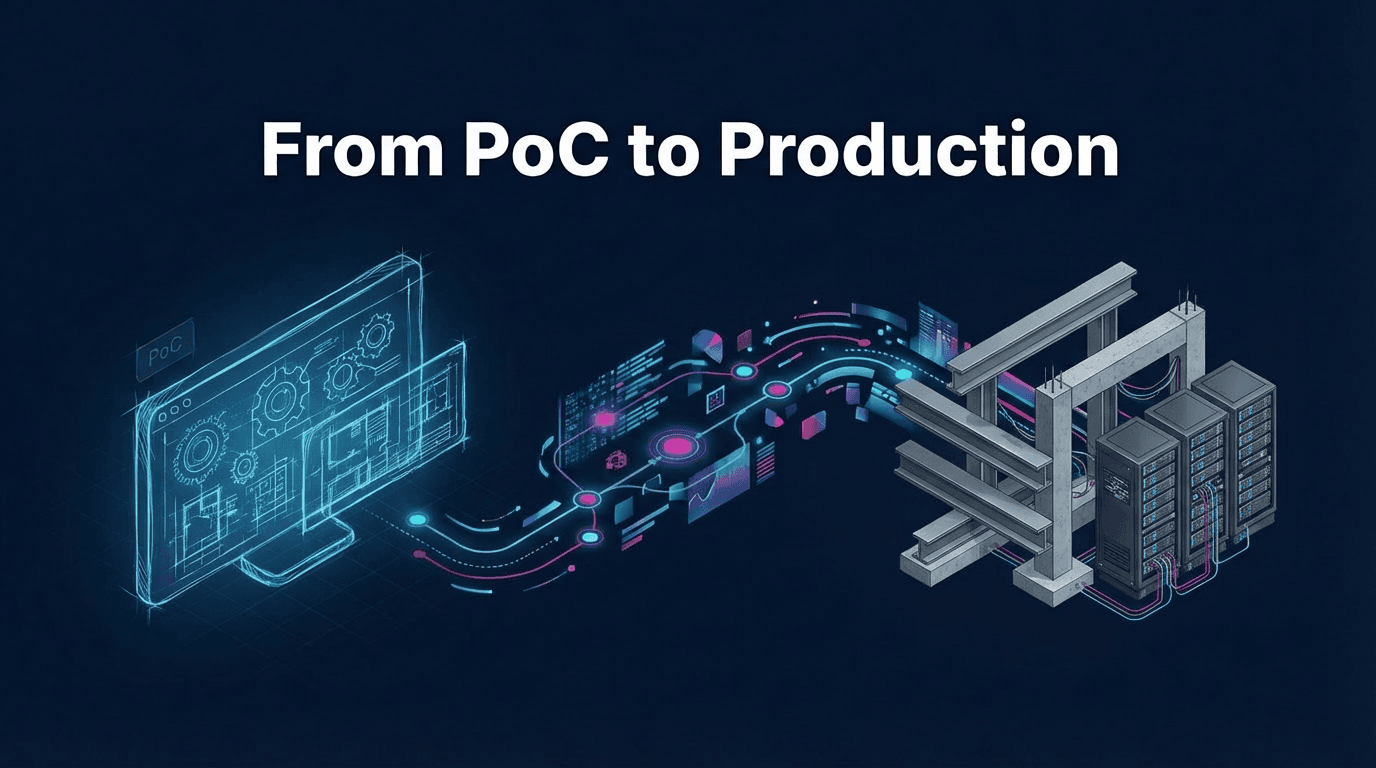
From PoC to Production: A Practical Playbook for shipping AI projects that actually Go Live
Every year, billions of dollars/euros are poured into AI initiatives. Gartner estimates that through 2025, 85% of AI projects will fail to deliver on their initial promises. The culprit is rarely the model. It is everything else: misaligned stakeholders, brittle data pipelines, absent MLOps practices, and the dangerous illusion that a working demo equals a production-ready system.
At Log-U, we have shipped AI systems across healthcare, industrial automation, financial regulation, and cloud infrastructure. This article is a distillation of what we have learned about the gap between a promising PoC and a system that runs reliably in production — and how to close it.
Stage 1: Problem Framing — The Most Underrated\
Phase
Most AI projects fail before a single line of code is written. The failure happens in the problem framing stage, when teams rush to pick a model architecture before they have clearly defined what success looks like.
Before any technical work begins, you need to answer four questions with precision:
- What is the specific decision or action this AI system will influence?
- What does 'good enough' look like, and how will you measure it?
- Who owns the outcome — and who will be accountable when the system is wrong?
- What is the cost of a false positive versus a false negative in your specific context?
When we worked on the support ticket management platform for Sword Health, the problem was not 'build an AI system.' It was 'reduce the time healthcare professionals spend triaging and routing support requests, without compromising patient ommunication quality.' That specificity shaped every technical decision that followed.
A useful exercise at this stage is to write the press release for the system before building it — not the technical spec, but the business outcome. If you cannot articulate the value in plain language, the project is not ready to start.
Stage 2: Data Readiness — The Honest Audit
The second stage is the one most teams skip or underestimate: a rigorous audit of data readiness. Not 'do we have data?' but 'do we have the right data, in the right shape, with the right quality, accessible in the right way?'
Data readiness has five dimensions:
- Availability: Does the data exist, and can you access it legally and technically?
- Quality: What is the rate of missing values, duplicates, and labelling errors?
- Relevance: Does the historical data reflect the conditions under which the model will operate?
- Volume: Is there enough labelled data for the approach you are considering?
- Latency: Can the data be delivered at the speed the system requires in production?
In our work with Emerson on acoustic particle monitoring, the data challenge was not volume — sensors generate enormous amounts of signal data. The challenge was relevance: historical data had been collected under different calibration conditions, making it unreliable for training inference algorithms. Recognising this early allowed us to design a system that tuned parameters dynamically at deployment rather than relying on pre-trained static models.
A data readiness audit typically takes one to two weeks and saves months of rework. It is not optional.
Stage 3: Model Selection — Boring is Often\
Better
There is a strong temptation in AI projects to reach for the most sophisticated model available. In practice, the best model for production is usually the simplest one that meets your performance requirements.
The reasons are practical:
- Simpler models are easier to debug when they fail in production.
- They are cheaper to run at scale.
- They are easier to explain to stakeholders and regulators.
- They degrade more gracefully when input data drifts.
A decision tree or a gradient boosting model that achieves 87% accuracy and runs in 2ms is almost always preferable to a transformer that achieves 91% accuracy and requires a GPU cluster. The 4% accuracy gain rarely justifies the operational complexity.
That said, there are contexts where large models are the right choice — particularly in natural language understanding, document processing, and multimodal tasks. The key is to make the selection based on production constraints, not on what is impressive in a demo.
Stage 4: MLOps Architecture — Building for Operability, not just Accuracy
A model that works on your laptop is not a product. The MLOps architecture is what transforms a model into a system that can be deployed, monitored, updated, and rolled back safely.
The minimum viable MLOps stack for a production AI system includes:
- A reproducible training pipeline (versioned data, versioned code, versioned environment)
- A model registry with metadata, performance benchmarks, and lineage tracking
- A deployment mechanism that supports canary releases and rollbacks
- An inference layer with latency and throughput monitoring
- A data quality monitor that detects drift in input distributions
- An alerting system tied to business metrics, not just technical metrics
In our infrastructure work for IONOS and the European Commission, we applied the same principles we use for AI systems: infrastructure as code (Terraform), container orchestration (Kubernetes), and GitOps-based deployment (ArgoCD). These are not AI-specific tools — they are engineering best practices that apply equally to ML workloads.
One principle we apply consistently: every model deployment should be as boring as a software deployment. If deploying a new model version requires heroics, the architecture is wrong.
Stage 5: Observability — You Cannot Manage What\
You Cannot See
Production AI systems fail in ways that are fundamentally different from traditional software. A bug in a REST API either works or it does not. A model can degrade silently — producing outputs that are technically valid but increasingly wrong — for weeks before anyone notices.
Effective observability for AI systems requires monitoring at three levels:
- Infrastructure level: CPU, memory, latency, error rates — the standard SRE toolkit.
Model level: prediction confidence distributions, feature importance drift, output distribution shifts.
- Business level: the downstream metrics the model is supposed to influence — ticket resolution time, false alarm rates, approval accuracy.
The business-level metrics are the most important and the most frequently absent. A model that maintains 90% accuracy on its internal benchmark while the business metric it was designed to improve is getting worse is a failing system, regardless of what the dashboard shows.
Stage 6: Continuous Improvement — The System that learns
Shipping to production is not the end of the project. It is the beginning of the most valuable phase: the feedback loop.
A production AI system should be designed from day one to capture the data it needs to improve. This means:
- Logging model inputs and outputs in a format that can be used for retraining
- Building mechanisms for human feedback (corrections, overrides, ratings)
- Scheduling regular model evaluation against fresh labelled data
- Defining clear triggers for retraining (performance thresholds, data volume milestones)
The teams that treat the initial deployment as a data collection exercise — rather than a finished product — are the ones that build systems that compound in value over time.
The Common Thread: Engineering Discipline
Looking across the projects we have delivered, the single most reliable predictor of AI project success is not the sophistication of the model. It is the engineering discipline applied to the system around the model.
The teams that ship AI to production are the ones that treat it as a software engineering problem first and a machine learning problem second. They invest in data infrastructure, they build for operability, they monitor business outcomes, and they plan for failure.
The PoC-to-production gap is not a technical problem. It is an engineering culture problem. And it is entirely solvable.
If you are navigating this journey and want a partner who has done it across industries and at scale, we would be glad talk!