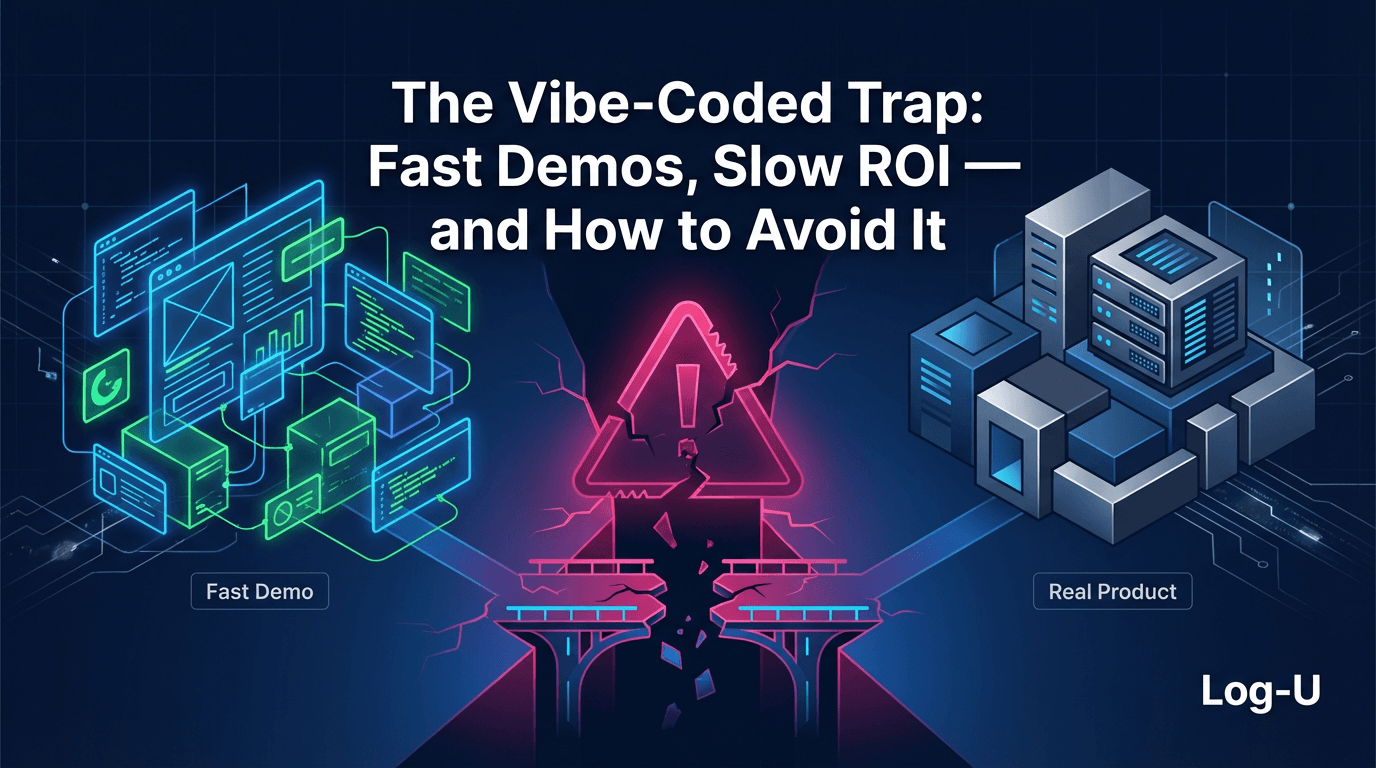
The Vibe-Coded Trap: Fast Demos, Slow ROI — and how to avoid it
We live in the era of ‘vibe‑coding.’ With modern LLMs, anyone can generate an application that looks impressive in a demo. But as a CEO who has delivered critical systems in finance, healthcare, and government, I’ve learned a simple truth: there is a massive difference between something that looks like software and something that works like a product. And that difference is where ROI is made—or destroyed.
Fast Demos are a Trap
Vibe‑coding gives you speed. You can prompt your way to a prototype in hours. It feels efficient, it feels modern, and it feels like progress.
But here’s the part few people talk about: vibe‑coded prototypes almost never translate into real products without a complete rewrite. The underlying architecture is fragile, the security assumptions are wrong, and the data flows don’t survive contact with real users.
Slow ROI: The hidden cost
This is where the real trap lies. The demo is fast—but the return on investment is slow, or never comes at all.
The reason ROI collapses is simple: vibe‑coding accumulates invisible technical debt. It solves the surface‑level problem (a UI that works, an API that returns something), but not the structural ones. When the system needs to scale, integrate with real data, comply with GDPR, or operate 24/7, everything breaks at once. The engineering effort required to fix it often exceeds what it would have cost to build it properly from the start. Free demos become expensive products.
This is why so many companies experience the same pattern: fast excitement, followed by months of refactoring, firefighting, and unexpected costs. The ROI curve doesn’t bend upward—it stalls.
Why Turn‑Key Leadership changes the equation
At Log‑U, we use AI too—but not as a replacement for engineering discipline. We use it as an accelerator in the hands of senior engineers who understand distributed systems, scalability, and long‑term maintainability.
Turn‑key delivery means we take responsibility for the entire lifecycle: architecture, data design, security, cloud orchestration, and clean implementation. AI gives us speed; engineering leadership ensures stability. It’s the combination that produces real ROI.
Avoiding the Trap
If you want fast demos, vibe‑coding is enough. If you want a real product—one that customers trust and that your team can maintain—you need experienced engineers leading the system design, using AI to increase velocity, not replace knowledge.
The fastest path to ROI is a system that works the first time it hits production. That’s what turn‑key engineering delivers.